Read Related Article: Different Types of Blenders for Your Kitchen: Best Blender Guide
Discover different types of blenders for your kitchen in this complete best blender guide. Compare features, uses, and find the right one for you.
Read More
.webp)

Use high heat, cook ingredients in batches to avoid overcrowding, and keep ingredients moving in the pan for even cooking.
Cook sliced onions slowly over low heat with a bit of oil or butter, stirring occasionally, until deeply browned and sweet.
Use a meat thermometer to check internal temperatures: 145°F for pork, 160°F for ground meats, and 165°F for poultry.
Most people inherit their oven the same way they inherit their kitchen, it came with the place. But if you've ever stood in a showroom (or scrolled endlessly online) trying to figure out whether you need a convection oven, a steam oven, or a wall oven, you already know the decision is more complicated than it looks.
This guide is not a list of specs pulled from manufacturer pages. It's a practical breakdown of how each oven type actually behaves in a real kitchen, what it's genuinely good at, where it falls short, and who it makes the most sense for. By the end, you'll know exactly which type matches how you actually cook.
A conventional oven does exactly what it says: it heats from the top and bottom using two separate elements. The bottom bake element handles most of the cooking; the top broil element kicks in for browning and finishing. There's no fan, no steam, no gimmicks, just radiant heat doing its job.
Here's something most articles won't tell you: the hot spots in a conventional oven are predictable. The back-right corner typically runs 10–15°F hotter than the center, and the top rack is always hotter than the bottom. Once you learn your oven's quirks, rotating your pans halfway through solves most uneven baking problems.
Where conventional ovens genuinely shine is in slow cooking and moisture-sensitive baking. Meringues crack and collapse in convection mode because the moving air dries the surface too fast, but in a conventional oven, they puff up perfectly. Custards, soufflés, and cheesecakes all behave more predictably without a fan. And for a slow-braised short rib or a casserole that needs three hours in a 300°F oven, the steady radiant heat is exactly what you want.
What most people get wrong: They assume "conventional" means outdated. It doesn't. Professional pastry chefs frequently choose conventional mode for specific tasks even when a convection setting is available. It's a tool, not a compromise.

Discover different types of blenders for your kitchen in this complete best blender guide. Compare features, uses, and find the right one for you.
Read MoreAdding a fan to an oven sounds minor. The results are not. Circulating air strips away the cool, moist air layer that surrounds food as it cooks, which means heat reaches the surface faster. In practical terms: convection cuts cooking time by roughly 25%, and it browns food more evenly because every part of the oven cavity is at the same temperature.
The standard rule is to reduce your recipe temperature by 25°F when switching from conventional to convection, or keep the temperature the same and check the food 20–25% earlier. Both work, but experienced cooks generally prefer lowering the temperature; it gives you more control over texture without risking a dried-out result.
Now, the distinction that actually matters at the appliance store: standard convection vs. true (European) convection. A standard convection oven adds a fan to the back wall. True convection adds a third heating element directly behind that fan. The difference is that with true convection, the air being circulated is actively heated, not just pushed around from the existing elements. The result is more consistent temperature across all racks, which is why you can successfully bake three trays of cookies at once without rotating a single one.
If the label says "true convection," "European convection," or "third element convection," that's the version worth paying for. If it just says "convection," it probably only has the fan.
Practical note: Convection is not ideal for foods with batters that need to set before browning, like quick breads, muffins, or delicate cakes. The moving air can cause them to lean, crust early, or develop an uneven dome. Use conventional mode for those.
The humble toaster oven has had a full reinvention over the past decade. Today's countertop ovens range from basic 1,200-watt models that handle toast and reheating, all the way to smart units drawing 1,800 watts with air fry, dehydrate, proof, and slow-cook functions built in.
One spec worth paying attention to: a full-sized wall oven or range typically draws 2,400–5,000 watts to preheat a cavity that's three to five times larger. A quality countertop oven preheats in 4–6 minutes versus 12–15 for a full oven, and uses considerably less electricity to cook a single tray of chicken thighs or reheat a pizza. For households of one to three people who cook mostly weeknight meals, a premium countertop oven can genuinely replace a full oven for 80% of daily cooking.
One honest caveat: countertop ovens run hot and unevenly compared to full-sized models. The heating elements are physically close to the food, which means the top of a baked item can brown before the center sets. If you bake seriously, multi-layer cakes, artisan bread, precision pastry, you'll still want a full oven. But for roasting vegetables, sheet-pan dinners, reheating leftovers (where they actually stay crispy, unlike a microwave), and air frying, a good countertop oven is one of the best kitchen investments available at its price point.
Worth knowing: Brands like Breville (the Joule Oven Air Pro), Cuisinart, and Ninja now offer countertop models with true convection elements and interiors large enough for a 13x9 baking pan, the minimum size needed for most casseroles and sheet pan meals.
Microwaves work by emitting electromagnetic waves at 2.45 gigahertz, a frequency that causes polar molecules, primarily water, to rotate rapidly and generate heat through molecular friction. The process works from the inside out, which is why your leftovers are sometimes scalding at the edges and cold in the middle: water content varies throughout the food, so heating is uneven.
Most people use their microwave at 100% power for everything, which is why food comes out rubbery or dried out. The fix is simple: use 50–70% power and longer time for most reheating tasks. Lower power allows heat to distribute before the exterior overcooks. For rice, pasta, and anything with a sauce, this single change produces noticeably better results.
There's also a meaningful difference between conventional magnetron microwaves and inverter microwaves. Standard microwaves cycle on and off at full power to simulate lower settings, which causes uneven heating. Inverter technology (offered by Panasonic, LG, and others) delivers a continuous stream of lower-intensity microwaves, which heats food more gently and evenly. It's a real improvement, not a marketing claim.
Microwave-convection combo units deserve more credit than they get. They can bake, roast, and brown using the convection element, and they preheat in minutes. In a small kitchen with limited oven space, a well-chosen combo unit can genuinely serve as both appliance. The tradeoff is interior capacity, most are smaller than a standard oven, and the learning curve of managing two cooking modes.
Standing time is cooking time: The 2-minute rest after microwaving is not optional. Heat continues redistributing through the food after the magnetron stops. Skipping it is why your food still has cold spots.
.webp)
Discover different types of sugar and how to use them in baking, cooking, and drinks. Learn when to choose white, brown, raw, or specialty sugars.
Read MoreSteam ovens are still relatively rare in American homes, which is a shame, because they solve a problem every cook faces: food that dries out in the oven. A pure steam oven injects water vapor into the cavity, cooking food in a 100% humid environment. The maximum temperature is capped at 212°F (the boiling point of water), which makes it perfect for vegetables, fish, eggs, and reheating, but not for roasting or browning.
The more versatile version, and the one most worth buying, is the combi-steam oven, which combines steam injection with a convection heating element. This lets you cook at any temperature from 86°F to 480°F with a controllable level of humidity. The practical applications are significant: you can bake bread with steam for the first 15 minutes (which keeps the crust soft enough to allow maximum rise before setting) and then switch to dry convection heat to develop the crust. Professional bakeries have done this for decades with deck ovens and steam injectors; a combi-steam oven replicates it at home.
From a health standpoint, steam cooking is the gentlest method available. Studies have shown it preserves 90–95% of water-soluble vitamins like vitamin C and B vitamins that are lost in boiling. It requires no added fat. And reheated food from a steam oven, unlike a microwave or conventional oven, comes out tasting close to freshly cooked because the moisture is being restored, not evaporated.
The barrier is cost. Entry-level combi-steam ovens from brands like Sharp and Miele start around $1,500, with top-of-the-line models from V-ZUG and Gaggenau exceeding $5,000. They are a long-term investment, but for the serious home cook or anyone managing health-focused cooking for a household, they change how you cook in ways that are hard to overstate.
Who it's really for: Steam ovens make the biggest difference for people who cook fish, vegetables, or grains frequently; bakers who want professional-quality bread at home; and households reheating food daily and tired of dried-out results.
Wall ovens are built into the cabinetry rather than sitting on the floor as part of a range. The most practical advantage is ergonomic: an oven door at chest or shoulder height means you're not bending down to check on a roast or pulling a heavy Dutch oven out at knee level. If you've ever burned your forearm on the top rack of a floor-level oven, you understand the appeal immediately.
They come in 24", 27", and 30" widths, with 30" being the standard in most new kitchen builds. Single wall ovens give you one full-sized cavity; double wall ovens stack two, letting you roast at 400°F in one and bake at 325°F in the other simultaneously, a genuine advantage during large holiday cooking.
One thing buyers consistently underestimate: the total cost. The appliance price is just the starting point. Professional installation, cutting cabinet space, running a dedicated 240V circuit, ensuring proper ventilation, typically adds $200–$800 to the purchase price. If you're doing a full kitchen renovation, that's a natural part of the budget. If you're retrofitting an existing kitchen, the infrastructure costs can be surprising.
Modern wall ovens from brands like KitchenAid, Bosch, and Wolf frequently include true convection, built-in probe thermometers, steam-assist features, and Wi-Fi connectivity. The steam-assist feature, standard convection with occasional steam injections, is a lower-cost middle ground between a pure steam oven and a standard convection oven, and it produces excellent bread crusts and tender roasts.
Single vs. double, the honest answer: Most households are well served by a single wall oven. The double version makes undeniable sense for people who regularly cook large holiday meals or who genuinely need two simultaneous oven temperatures. For everyday cooking, the extra cavity mostly goes unused.
The range oven, a cooktop and oven in a single freestanding or slide-in unit, is the most common oven format in homes worldwide, and the decision most buyers face comes down to fuel: gas, electric, or induction. Each has real advantages, and the debate is more nuanced than the internet arguments suggest.
Gas ranges deliver instant, visible heat and precise flame control that experienced cooks find intuitive. Residential gas burners typically output 9,000–18,000 BTU per burner; professional-style ranges push 15,000–25,000 BTU, which allows faster boiling and better searing. The oven on a gas range, however, heats from a single burner at the bottom and is generally less even than an electric oven. Gas ovens also introduce some moisture into the cavity through combustion, which can affect the crispness of roasted foods.
Electric ranges have the opposite profile: the cooktop is slower to respond and harder to control at very low heat, but the oven, especially with a true convection element, is more precise and more even. For bakers, an electric oven is generally the preferred choice. Electric smooth-top ranges also make kitchen cleanup significantly easier than gas grates.
Induction ranges are now genuinely worth considering as a mainstream option. Induction uses electromagnetic fields to heat the cookware directly rather than heating the burner surface, which means the cooktop itself stays cool, the kitchen stays cooler, and response time is faster than gas for high-heat tasks. The catch: you need induction-compatible cookware (magnetic-base pans, most stainless steel and cast iron qualify). If you have an all-copper or aluminum batterie de cuisine, you'd need to replace it.
Dual-fuel ranges, a gas cooktop paired with an electric oven, offer the best of both worlds but carry a meaningful price premium, typically starting at $1,800 and climbing well above $5,000 for professional-style models. They require both a gas line and a 240V electrical connection, which adds installation complexity.
The freestanding vs. slide-in question: Slide-in ranges have no side panels and are designed to fit flush with the counter, giving a built-in look. They typically cost $200–$500 more than equivalent freestanding models. The functional difference is minimal; the aesthetic difference is significant.
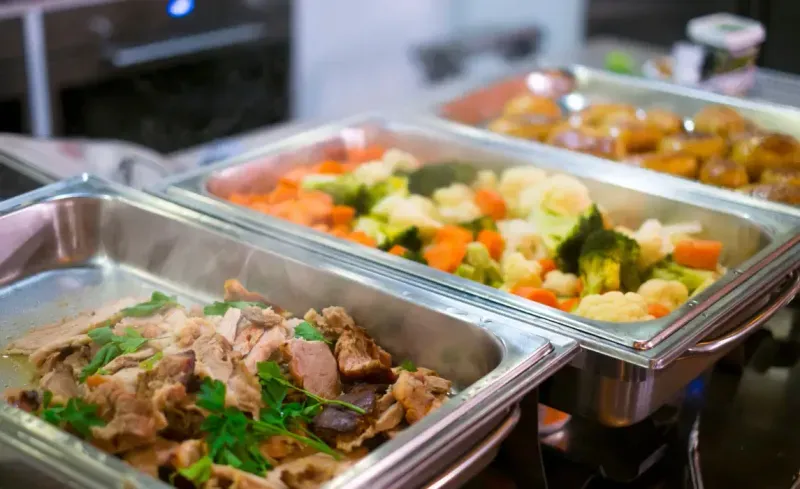
Discover the best buffet food warmer trays and electric buffet servers to keep dishes hot and ready for parties, holidays, and gatherings.
Read MoreCommercial ovens are built to a different standard than anything in the residential market. They run continuously through 12–16 hour service shifts, recover to target temperature in under 5 minutes between loads, and are constructed to be disassembled, cleaned, and reassembled daily. Understanding what they do well helps explain what home ovens can and can't replicate.
Deck ovens are the backbone of artisan bakeries. A thick ceramic or stone deck stores thermal energy and transfers it directly into the bottom of bread and pizza, replicating the effect of a stone hearth that has been heating for hours. This bottom-up radiant heat creates the dense, chewy crumb and dark, crackling crust that's impossible to achieve on a standard oven rack. High-end home baking stones get you partway there; a real deck oven, which can sustain 600°F+ indefinitely, is a different category entirely.
Conveyor ovens move product on a belt through a temperature-controlled tunnel at a fixed speed. The speed of the belt determines doneness. They're what fast-casual pizza chains use to produce consistent, high-volume output with untrained staff. Quality is always a compromise for the sake of throughput.
Combi ovens, the most versatile and expensive category, combine steam and convection in a single programmable unit. A well-programmed combi oven can cook 200 portions of chicken breast to exactly the same internal temperature simultaneously, a feat no home oven comes close to. Restaurant-grade units from Rational, Alto-Shaam, and Convotherm start around $5,000 and scale well past $20,000.
Can you put a commercial oven in your home? Technically, sometimes. Practically, usually not. Commercial ovens require heavy-duty gas lines, industrial ventilation hoods, and three-phase electrical service in many cases. They also radiate significantly more heat than residential models, raising insurance and fire code concerns. A handful of prosumer and professional-style residential brands (Wolf, Thermador, La Cornue) bridge the gap with residential-rated equipment that approaches commercial performance.
The physics of great pizza require two things that standard ovens can't provide: very high floor temperature and radiant heat from above. Neapolitan pizza is cooked at 800–900°F for 60–90 seconds. At that temperature, the crust chars and blisters while the center stays soft and the toppings barely cook, a combination of textures that's entirely different from pizza baked at 500°F for 10 minutes.
Wood-fired pizza ovens achieve this through thermal mass, the thick brick or stone walls absorb heat over 1–2 hours of firing and then radiate it intensely and evenly. Modern home pizza ovens from brands like Ooni and Gozney use propane or wood pellets to reach 900°F in 20–30 minutes, making them genuinely accessible for home use. The Ooni Koda 16 and Gozney Dome are the benchmark models; they produce authentic Neapolitan results on a home patio at a fraction of the cost of a built-in masonry oven.
The tandoor is a cylindrical clay oven that has been used across South and Central Asia for thousands of years. Charcoal or wood burning at the base heats the clay walls to 480–900°F depending on the firing stage. Marinated meats (tikka, seekh kebab) and raw naan dough are pressed against the interior walls and cook in minutes, picking up a distinctive smokiness and char from direct contact with the heated clay.
The mechanism is different from any Western oven: food cooks through a combination of intense radiant heat from the walls, convection from the rising hot air column, and in the case of naan, direct conduction through the clay surface. Home tandoor units are available in compact electric and small charcoal versions, but they're a niche investment that makes sense primarily if tandoor cooking is a meaningful part of how you cook.
A rotisserie's advantage isn't just slow rotation, it's self-basting. As the spit rotates, fat renders from the cooking surface and runs around the outside of the meat before dripping off, continuously moistening the exterior. This is why rotisserie chicken has such distinctive texture: the skin is crispy all the way around, and the breast meat, the part that always dries out when roasting flat, stays juicy because the bird is never resting in its own juices on one side.
Dedicated countertop rotisserie ovens (the classic George Foreman / Cuisinart style) do this well at relatively low cost. Many full-sized ranges also include rotisserie accessories that mount in the oven cavity. If you roast whole birds or legs of lamb with any frequency, it's a feature worth seeking out.
The Dutch oven is not an appliance, it's a heavy cast iron or enameled pot with a tight-fitting lid used inside a conventional oven. It's worth including here because it genuinely replicates the function of a professional steam-injected deck oven for bread baking. Bread dough releases moisture as it bakes; a sealed Dutch oven traps that steam around the loaf for the first 20 minutes, allowing maximum oven spring before the crust sets. The result, a blistered, crackly crust and open crumb, is what most home bakers spend years trying to achieve. If you bake bread and don't own a Dutch oven, buy one before you buy any other baking equipment.

Learn how to wash dishes by hand with this complete guide. Discover step-by-step tips for cleaner, grease-free dishes and proper drying.
Read MoreThere's a tendency in buying guides to reduce this decision to a matrix, match your budget to a category, pick the highest-rated model, done. In practice, the right oven is the one that matches how you actually cook, not how you imagine you might cook after the purchase.
Start by being specific about three things: what you cook most often, how many people you cook for, and what's already in your kitchen infrastructure. An avid baker who makes bread twice a week should think seriously about convection or steam. A family of five cooking dinner every night on a tight budget is well served by a quality gas or electric range. Someone in a studio apartment who reheats more than they cook should be looking at a premium countertop oven, not a full-sized range they'll use twice a week.
Infrastructure matters more than most buyers realize. Installing a gas range in a kitchen without a gas line means running new pipe, typically $300–$700, sometimes more. Switching from gas to electric requires a 240V outlet that many older kitchens don't have. If your building only has 120V outlets available, you're limited to countertop options. Check before you shop.
A practical question to guide your decision:
• If you bake bread or pastries more than once a week → prioritize true convection or a combi-steam oven
• If you cook for a family of 4+ every night → a 30" gas or dual-fuel range gives you the most versatility
• If you cook for 1–2 people and maximize convenience → a quality countertop convection oven may genuinely replace your full oven for daily use
• If kitchen aesthetics and ergonomics are a priority → wall ovens offer a built-in look and comfortable working height
• If you cook fish, grains, and health-focused meals daily → a steam or combi-steam oven is the long-term investment that changes how you eat
• If you make pizza at home seriously → a portable pizza oven like the Ooni Koda will do more for your pizza than any kitchen oven upgrade
Even after reading a thorough guide, a few practical questions tend to come up every time someone is actually standing in a store or configuring an online cart. Here are the three that come up most often, answered directly.
It depends entirely on what you're cooking. For roasting vegetables, baking cookies, and browning meats, convection is genuinely better, the circulating air removes the moisture buffer around food, which speeds up caramelization and produces a crispier exterior. For delicate items like soufflés, custards, cheesecakes, and most quick breads, a standard conventional oven is the better choice because the still air lets the interior set before the surface browns. The good news is that most modern ovens include both modes, so you're not forced to choose, you just need to know which one to reach for.
For everyday cooking tasks, reheating, small meals, weeknight dinners, a quality countertop convection oven is the most energy-efficient option by a significant margin. It preheats in 4–6 minutes and heats only the space the food actually occupies. A full-sized oven, by comparison, preheats a cavity 3–5 times larger and takes 12–18 minutes to do it, even when you're only cooking a single tray of vegetables. For larger meals or batch cooking, a full range or wall oven is the appropriate tool, but running a full-sized oven for one portion of food is one of the most common energy wastes in the kitchen. The microwave is even faster and more efficient for reheating specifically, but it can't replicate the texture results of dry heat.
A well-maintained residential oven typically lasts 13–15 years for electric models and 15–17 years for gas. The most common failure points are the heating elements on electric ovens (usually a $20–$50 part that's user-replaceable) and the igniter on gas ovens (also inexpensive to replace). If your oven is more than 10 years old and you're facing a repair bill over $300–$400, replacement usually makes more financial sense than repair, especially since newer models are meaningfully more energy-efficient and often include features like true convection and better temperature accuracy that weren't standard a decade ago. The clearest signal that it's time to replace rather than repair: if your oven consistently runs more than 25°F off the set temperature even after calibration, the thermostat or control board is degrading and accuracy will only get worse.
.webp)
.webp)
