There is a specific moment that happens at dinner parties when fresh pasta is served. It does not matter whether it is tagliatelle tossed in a brown butter sage sauce or ravioli stuffed the afternoon before, guests notice. They slow down. They ask questions. Somewhere between the first bite and the second glass of wine, the meal becomes a memory.
That moment, however, depends on what happened in your kitchen before anyone arrived. And more than the recipe, more than the flour or the eggs, it depends on whether you had the right machine for the job.
This is the problem most buyers run into: pasta makers are not one-size-fits-all. The machine that works beautifully for a solo cook making linguine on a Sunday afternoon is not necessarily the machine that gets you through a lasagne for fourteen on Christmas Eve. The features that matter in a showpiece dinner-party setting are completely different from what matters when you are batch-rolling sheets for sixty minutes before guests knock on the door.
This guide is for home hosts who entertain regularly, cooks who are upgrading from dried pasta and want to understand what they are buying into, and anyone shopping for a gift that will actually get used. It covers every major pasta maker type, how each works, what it makes, and how it performs under real hosting conditions. By the end, you will know exactly which type fits your kitchen, your budget, and your guest count.
What Makes a Pasta Maker "Entertaining-Ready"
Not every pasta machine is designed with a crowd in mind. Most are designed for the lone cook experimenting on a weeknight. That is fine, but it is worth understanding the difference before you spend money.
When you are cooking for guests, four things matter above anything else.
Batch output
How much dough can the machine process in a single session? A machine that handles 100 grams of dough at a time is a very different tool from one that rolls continuously for twenty minutes without stopping.
Speed
There is a real difference between pasta that comes out at hand-cranking pace and pasta that a motor produces. When you have guests arriving in ninety minutes and you still need to set the table, roll the pasta, and let it dry, speed is not a luxury, it is logistics.
Cleanup window
Some machines require twenty minutes of careful cleaning with a brush and a toothpick. Others come apart in thirty seconds. If you are entertaining, your cleanup window is the gap between finishing the pasta and starting everything else. A machine that fights you on cleanup will ruin your timeline.
Dough compatibility
Not all machines handle all doughs. Egg-based doughs behave differently from semolina doughs, and enriched doughs (with spinach, squid ink, or beet) behave differently again. Knowing what your machine can handle before you plan a menu matters.
The size of your typical gathering should drive your machine choice. A dinner for four to six guests is an entirely different proposition from a holiday table for twelve or fourteen. Both are achievable with home equipment, but not necessarily the same equipment.
Read Related Article: Best Easy Coffee Dessert Recipes for Gatherings & Entertaining
Discover the best easy coffee dessert recipes perfect for gatherings and entertaining. From creamy tiramisu to mocha treats and no-bake delights, these crowd-pleasing desserts add a rich coffee flavor guests will love.
Read More
The Main Types of Pasta Makers
Type 1: Manual Crank Pasta Machines
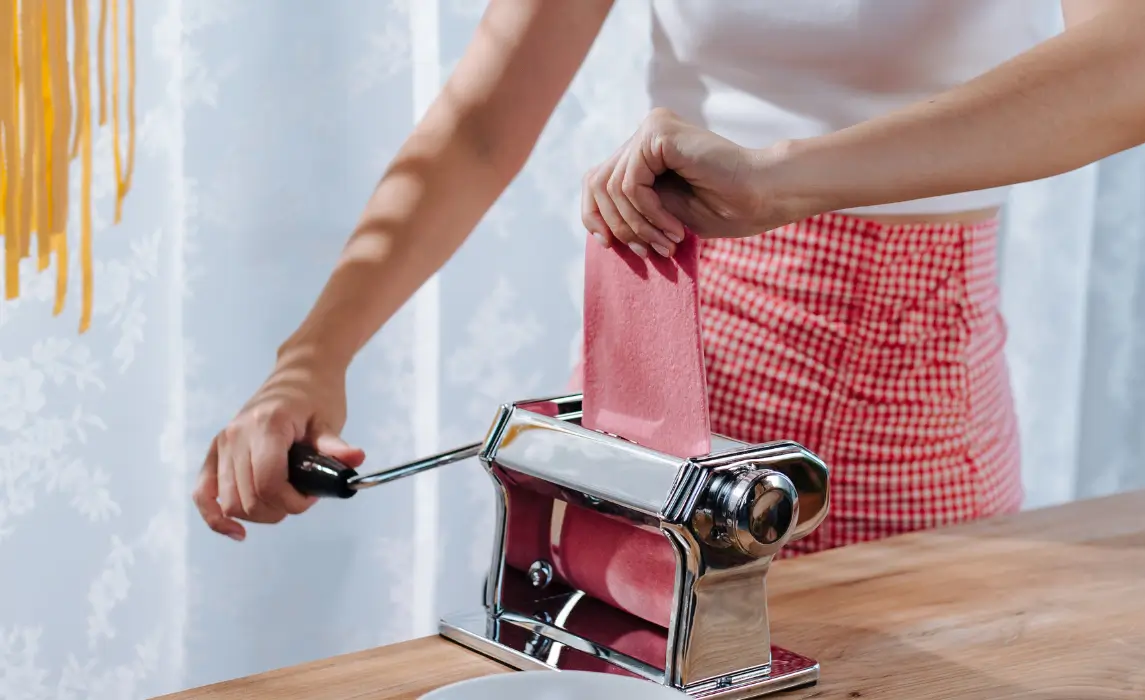
The manual crank machine is the original. It clamps to your countertop or table edge, and you feed dough through the rollers while turning a handle on the side. The gap between the rollers adjusts via a numbered dial, typically from setting one (thickest) down to setting nine (paper-thin). Most machines include at least two cutter attachments, one for fettuccine, one for tagliatelle or spaghetti, and additional cutters can be purchased separately.
What it makes: Flat, rolled pasta. Fettuccine, tagliatelle, pappardelle (cut by hand from rolled sheets), lasagne sheets, linguine. With a ravioli attachment, stuffed pasta too.
Best for: Intimate gatherings of two to six guests, cooks who enjoy the process and the tactile nature of handmade pasta, kitchens where counter space is limited and storage matters.
Entertaining pros: Completely quiet. No power cord. Precise control over thickness, which matters when you want ultra-thin pasta for delicate fillings. The process itself is theatrical, if guests are in the kitchen, a manual machine becomes part of the evening. People want to take a turn.
Entertaining cons: The honest truth is that for more than six people, manual rolling becomes a physical project. Someone needs to hold the dough while someone else turns the crank, or you develop a one-armed technique that takes time to master. Output is slow relative to the work. If you are the sole host, prep time doubles.
What to look for: All-steel or chrome construction, avoid plastic where possible. Nine or more thickness settings. Included cutting attachments rather than separately purchased accessories. A solid clamp that holds to your table without wobbling.
Price range: $30–$120
Marcato Atlas 150
Learn about the Marcato Atlas 150, a popular manual pasta maker known for its durable design, smooth rollers, and versatility for making fresh homemade pasta with ease.
Buy Now
Electric Pasta Maker- Imperia Pasta Presto
Discover the Imperia Pasta Presto, an electric pasta maker designed for quick and effortless homemade pasta. Learn about its features, convenience, and why it’s a favorite for easy fresh pasta preparation.
Buy Now
Representative machines: Marcato Atlas 150, Imperia, CucinaPro
Type 2: Electric Motorized Pasta Machines
The electric motorized machine is functionally a manual machine with a motor attached in place of the hand crank. The rollers work identically, but the motor drives them, leaving both your hands free to guide and catch the dough. Some models are purpose-built electric machines; others are manual machines with a motor attachment sold separately.
What it makes: Everything the manual machine makes, fettuccine, tagliatelle, lasagne sheets, linguine, with the addition of speed and consistency across larger batches.
Best for: Solo hosts who need to produce significant quantities without a second pair of hands. Regular entertainers who make pasta monthly or more. Anyone who finds the physical effort of hand-cranking prohibitive.
Entertaining pros: The motor frees your hands at exactly the point where you most need them, guiding dough through the rollers cleanly and catching it before it tears. This makes it practical for one person to produce pasta for eight without exhaustion. Thickness is more consistent across long batches because human crank speed no longer varies with fatigue.
Entertaining cons: Significantly louder than a manual machine, not conversation-stopping, but noticeable. Bulkier footprint and heavier to store. More expensive at entry level. Harder to clean because the motor housing cannot be submerged or rinsed.
What to look for: Wattage matters for dough resistance, look for at least 100W for regular home use. Roller width (150mm is standard). Whether cutting attachments are included or separate. Noise level is rarely listed in specs, so reviews are a more reliable indicator.
Price range: $150–$350
Lello 2730 3000 PastaMaster Automatic Pasta Maker
Discover the Lello 2730/3000 PastaMaster, a durable automatic pasta maker designed for quick, high-volume fresh pasta making at home.
Buy Now
Philips Kitchen Appliances Compact Pasta and Noodle Maker
Discover the Philips Compact Pasta and Noodle Maker, a convenient appliance that lets you make fresh pasta and noodles quickly at home with minimal effort and customizable shapes.
Buy Now
Representative machines: Imperia Electric, Lello Pastamaster, Philips motorized models
Type 3: Pasta Extruder Machines
The extruder works on a completely different principle from the roller. Instead of pressing dough flat between two rollers, the extruder pushes dough through a shaped die using an auger or piston mechanism. The die shape determines the pasta shape, swap the die, change the pasta. Most machines come with six to twelve dies included, and additional dies can be purchased.
What it makes: Tube and extruded shapes. Rigatoni, penne, spaghetti, bucatini, fusilli, maccheroni, and more. It does NOT make flat pasta, and it cannot produce stuffed pasta. It is the wrong tool for lasagne or ravioli.
Best for: Casual entertaining and family-style meals where variety and volume matter more than presentation. Hosts who want to serve something other than ribbon pasta. Large gatherings where a big pot of rigatoni is the objective.
Entertaining pros: Shape variety is genuinely impressive and a conversation starter. Extruded pasta handles bold, chunky sauces extremely well, rigatoni with a slow-cooked ragù reads as a restaurant meal. Producing large quantities of a single shape is faster than rolling and cutting flat pasta. The shapes hold sauce in ways that ribbon pasta cannot.
Entertaining cons: Extruders require a stiffer, drier dough than rollers, the learning curve here is real. The dies are intricate and difficult to clean properly without soaking. The machines that do this well are at the higher end of the price range. And the output, while impressive, reads as more casual than hand-rolled flat pasta.
What to look for: The number of included dies and the material they are made from. Brass dies produce a rougher surface texture on the pasta that holds sauce significantly better than smooth plastic dies, worth paying for if sauce adhesion matters to you. Motor power for consistent extrusion pressure.
Price range: $80–$400+ / approximately ₱4,600–₱23,200+
Representative machines: Philips Pasta Maker 7000 Series, Ariete, Bottene Titania
Philips 7000 Series Pasta Maker
Discover the Philips 7000 Series Pasta Maker, a smart appliance that lets you make fresh, customized pasta at home quickly and effortlessly.
Buy Now
Type 4: Stand Mixer Pasta Attachments
If you already own a stand mixer, most commonly a KitchenAid, pasta roller and cutter attachments let you use its existing motor to drive pasta-making functions. The roller attachment replaces the pasta machine entirely. The cutter attachments add fettuccine, spaghetti, and other shapes. These are sold individually or as a bundled set.
What it makes: Flat pasta with the roller attachment, tagliatelle, fettuccine, lasagne sheets. Additional cutter attachments add more shapes. The pasta extruder attachment (sold separately) adds some extruded shapes.
Best for: Hosts who are already invested in the stand mixer ecosystem and do not want another appliance taking up space. Kitchens where counter space and storage are at a premium. Cooks who want versatility across baking and pasta-making in one machine.
Entertaining pros: The stand mixer motor is powerful and consistent. Switching between attachments mid-prep session is fast. No additional storage footprint if you are already storing a stand mixer. The output quality is excellent, comparable to a dedicated electric machine.
Entertaining cons: The attachments only work with compatible mixers, this is not a universal system. Buying attachments individually adds up quickly, and the full set is more expensive than many standalone machines. Output speed depends on your mixer's motor tier. Cheaper or older mixer models may struggle with heavy semolina doughs.
What to look for: Attachment compatibility with your specific mixer model and year. Roller width. Whether the bundle includes cutter attachments or just the roller. Build quality of the attachments themselves, the KitchenAid branded set is more durable than third-party alternatives.
Price range: $70–$200 / approximately ₱4,000–₱11,600 (attachments only, mixer not included)
Representative attachments: KitchenAid 3-Piece Pasta Roller and Cutter Set, Marcato Atlas Motor Attachment
Read Related Article: Easy Cold Appetizers to Make Ahead: Quick and Delicious Ideas
Discover easy cold appetizers to make ahead for parties, gatherings, and entertaining. Explore quick, delicious, and crowd-pleasing recipes that save time while impressing your guests.
Read More
Type 5: All-in-One Automatic Pasta Makers
The all-in-one automatic machine does everything: you add flour and eggs (or just the measured ingredients the manual specifies), press a button, and pasta comes out the other end ready to cook. The machine mixes, kneads, and extrudes automatically. No dough-making skill required.
What it makes: Extruded shapes primarily, spaghetti, penne, fettuccine (via flat die), and whatever shapes the included dies support. Some models can roll flat sheets, though this is a secondary function.
Best for: Beginners who want fresh pasta without the learning curve. Time-pressed hosts who need to produce pasta quickly without prep time overhead. Households where ease consistently outweighs craft.
Entertaining pros: The fastest path from raw ingredients to finished pasta of any machine type. Genuinely impressive to guests who do not know how it works, watching pasta come out of a machine without any human skill involved creates a moment. Minimum skill barrier means it gets used consistently rather than sitting in the box.
Entertaining cons: The dough quality is less nuanced than hand-made or roller-made pasta, you give up control for convenience. Thickness and texture customization is limited by what the machine's programming allows. These machines are expensive for what they are. Cleaning is more involved than the marketing suggests.
What to look for: Capacity in grams per batch, this matters enormously for entertaining and varies significantly across models. Number and material of included dies. Total cycle time from ingredients to finished pasta. Ease of disassembly for cleaning.
Price range: $200–$500+ / approximately ₱11,600–₱29,000+
Representative machines: Philips Pasta & Noodle Maker 7000 Series, Philips Viva Collection
Type 6: Ravioli and Stuffed Pasta Makers
This category covers specialty molds, trays, and attachments that press, fill, and seal stuffed pasta. They are not standalone machines, they work in tandem with a roller (manual, electric, or stand mixer) to produce the flat sheets they need. The ravioli maker itself handles only the cutting and sealing step.
What it makes: Ravioli in various sizes, agnolotti, cappelletti, and with enough skill, tortellini. The filling options are entirely up to you, meat, cheese, vegetable, seafood, or dessert fillings all work.
Best for: Hosts who want a showpiece dish where the pasta itself is the main event. Dinner parties where the filling can be personalized per guest, one ravioli with truffle ricotta, another with pumpkin and amaretti, for a distinctly restaurant-quality experience. Any gathering where the presentation matters as much as the taste.
Entertaining pros: Maximum visual impact of any pasta type. Stuffed pasta can be made completely ahead, assembled, placed on a floured tray, and refrigerated for up to twenty-four hours before cooking. The filling is infinitely customizable for dietary needs and preferences. Nothing on a dinner table signals effort more clearly than fresh ravioli.
Entertaining cons: Time-intensive regardless of how organized you are. A roller machine is a prerequisite, so this adds cost on top of the roller you already need. Not practical for very large groups without significant advance preparation, scaling stuffed pasta to twelve or more portions is a multi-hour project.
What to look for: Mold size options, larger ravioli squares are faster to fill and seal than small ones. Whether the attachment is compatible with your existing roller. Seal quality, the edges need to close completely or the filling leaks during cooking.
Price range: $15–$80 / approximately ₱870–₱4,600
Representative tools: Marcato Ravioli Attachment, Imperia Raviolamp, CucinaPro Ravioli Mold Set
KitchenAid 3-Piece Pasta Roller and Cutter Set
Discover the KitchenAid 3-Piece Pasta Roller and Cutter Set, a versatile attachment that lets you roll and cut fresh pasta at home with ease.
Buy Now
| Type |
Best For |
Output Speed |
Shapes Made |
Price Range (USD) |
Entertaining Score |
| Manual Crank |
Small gatherings |
Slow |
Flat pasta |
$30–$120 |
★★★☆☆ |
| Electric Motorized |
Regular hosts |
Medium–Fast |
Flat pasta |
$150–$350 |
★★★★☆ |
| Extruder |
Family-style, casual |
Fast |
Tubes & shapes |
$80–$400+ |
★★★★☆ |
| Stand Mixer Attachment |
Existing mixer owners |
Medium |
Flat pasta |
$70–$200 |
★★★★☆ |
| All-in-One Automatic |
Beginners, busy hosts |
Fastest |
Extruded |
$200–$500+ |
★★★☆☆ |
| Stuffed Pasta Maker |
Showpiece dinners |
Slow |
Stuffed only |
$15–$80 |
★★★★★ |
How to Choose the Right Pasta Maker Type for Your Hosting Style
The best machine is the one that matches how you actually entertain, not the one with the most features or the highest price point.
The Frequent Entertainer (6–10 guests monthly)
An electric motorized machine or stand mixer attachment makes the most sense here. You need consistent output, you need to do it alone, and you need to do it regularly without it becoming a burden. The motor investment pays off quickly when pasta night happens more than once a month.
The Holiday Host (once or twice a year, 10+ guests)
An all-in-one automatic or a pasta extruder handles volume better than a manual roller at this scale. You are not trying to showcase craft, you are trying to feed fourteen people without losing the evening to the kitchen. Speed and batch size win.
The Intimate Dinner Party Host (4–6 guests, food-forward)
A manual crank machine paired with a ravioli mold is the best combination for this context. The guest count is manageable, the process can be part of the entertainment, and stuffed pasta delivers an impact that no other machine type matches at this scale.
The Beginner Who Wants to Impress
An all-in-one automatic. The learning curve is minimal, the results are reliable, and guests do not know the difference between machine-extruded and hand-rolled pasta unless you tell them.
The Serious Cook Who Hosts
The full combination, manual crank or stand mixer roller for flat pasta, ravioli attachment for stuffed pasta, and possibly an extruder for variety. This is the kitchen of someone who has thought carefully about what they want to serve at different occasions and bought accordingly.
Budget framing
Under $100 gets you a solid manual machine, the right tool for small, thoughtful gatherings. Between $150 and $250 gets you into motorized territory where solo hosting becomes genuinely practical. Above $300, you are buying convenience, capacity, or a specialty function. None of that spending is wasted if it matches how you cook. All of it is wasted if it does not.
Read Related Article: Different Types of Ovens: Choose the Right Oven Type
Explore the different types of ovens and learn how to choose the right oven for your cooking needs. Compare features, benefits, and uses for conventional, convection, wall, toaster, and smart ovens.
Read More
Tips for Using Any Pasta Maker When Entertaining
Make the dough ahead
Fresh pasta dough needs to rest after mixing, at minimum thirty minutes, ideally one hour. The gluten relaxes, the dough becomes pliable, and it rolls without springing back at every pass. Make dough the night before, wrap it tightly in plastic, and refrigerate it. Bring it to room temperature for thirty minutes before rolling.
Pre-roll and semi-dry before guests arrive
This is the single most useful technique for entertaining. Roll your sheets, cut your shapes, and lay them on a lightly floured surface or hang them on a pasta drying rack. Let them air-dry for twenty to forty minutes until they are no longer tacky. They hold their shape, they cook evenly, and they are completely ready to drop into boiling water the moment you need them.
Use the pasta station as entertainment
For small gatherings, set up the roller on the kitchen counter and let guests take a turn during the pre-dinner hour. It is participatory, it is interesting, and it removes the pressure of performing in the kitchen alone. This works best with a manual crank machine, the physicality is part of the appeal.
Batch math
As a working rule: 100 grams of flour per person for a pasta course, 150 grams per person if pasta is the main. A standard large egg per 100 grams of flour for egg-based dough. Scale up from there. For stuffed pasta, count on slightly more per person because filling volume replaces some pasta volume.
Flour matters more than most people think
Italian 00 flour produces the silkiest, most delicate flat pasta, ideal for stuffed pasta and thin ribbons. Semolina produces firmer, rougher pasta that holds sauce well and is better suited to extruded shapes. All-purpose flour works as a substitute when 00 is unavailable but produces a slightly less refined result. Do not mix flour types without knowing why.
Cleaning is not optional and not flexible
Most manual and electric roller machines must never be washed with water, moisture causes rust in the rollers. Brush out dried dough with a stiff pastry brush or the cleaning brush included with the machine. For extruder machines, the dies need to soak and be cleaned individually, budget time for this after the meal, not before.
Frequently Asked Questions
Which pasta maker type is best for beginners?
An all-in-one automatic. It handles mixing, kneading, and extruding with minimal input from you, no dough skill required, reliable results every time.
Can I make ravioli with a regular pasta machine?
Yes. The roller produces the flat sheets; a separate ravioli mold (typically $15–$40) handles the stamping and sealing. The two work together, not interchangeably.
How much dough do I need per person?
Plan for 100g of flour per person for a pasta course, 150g if pasta is the main. One large egg per 100g for egg-based dough.
Final Verdict
For most home entertainers, people who host monthly or a few times a year, who cook for six to ten guests, and who want pasta to be genuinely impressive without being a production, the electric motorized machine or stand mixer attachment is the right starting point. Both free your hands, both produce consistent output, and both scale to a real dinner party without exhausting you before the guests arrive.
For budget-conscious hosts: a manual crank machine in the $50–$80 range from a reputable brand is all you need for gatherings under six people. Buy the ravioli mold attachment and the output quality rivals machines that cost four times as much.
For the serious, food-forward dinner party host: build the combination. A roller for flat pasta, a ravioli attachment for stuffed shapes, and the knowledge of what dough works when. The investment is spread across multiple purchases, but the result is a kitchen that can produce almost any pasta dish a restaurant menu would list.
One last thing worth saying plainly: the machine that gets used is always better than the machine that sits in the box. Buy for the way you actually cook and entertain, not for the version of yourself who makes pasta every Sunday. The right machine is the one that comes out of the cupboard.
Price ranges are approximate and subject to change. USD prices converted to PHP at a rate of approximately ₱58 per $1. Check current local pricing before purchasing.




-p-800.webp)
.webp)
.webp)
