There's a reason grazing boards show up at every gathering worth attending. They're abundant without being fussy, beautiful without requiring culinary training, and flexible enough to work for a dinner party of six or a backyard celebration of sixty. If you've ever stood in front of a stunning spread and thought I could never pull that off, this guide will change your mind.
Grazing Board vs. Charcuterie Board: They're Not the Same Thing
Before anything else, let's clear up the most common point of confusion in the entertaining world.
Charcuterie is a French culinary term that refers specifically to the craft of preparing and preserving meats, prosciutto, salami, soppressata, pâté, rillettes. A traditional charcuterie board is built around those cured meats, with accompaniments chosen to complement them: pickles, whole grain mustard, aged cheeses, cornichons.
A grazing board is the broader, more inclusive version. It can contain cured meats, but it doesn't have to. Fruits, vegetables, dips, bread, crackers, sweets, nuts, spreads, anything goes. A grazing board can be fully vegetarian, completely dessert-based, or built around a seasonal theme.
The simplest way to think about it: charcuterie is a category. Grazing is the concept. When someone calls their fruit-and-cheese spread a "charcuterie board," they're not catastrophically wrong, the terms have blurred in everyday use, but if you're building something eclectic and abundant, grazing board is the more accurate label, and the more useful one when planning.
Why a Grazing Board Is the Smartest Thing You Can Serve at a Party
The practical appeal is obvious, no cooking, no timing, no plating. But the deeper reason grazing boards have become an entertaining staple is social.
Food that sits in the center of a table creates conversation. Guests who don't know each other find a natural talking point. Someone asks what the soft cheese is. Someone reaches for the same cracker at the same time. The board acts as a social anchor in a way that a plated appetizer simply never could.
They also solve one of the most common hosting headaches: dietary variety. A well-built grazing board naturally accommodates different preferences without requiring you to cook separate dishes. Vegetarians graze from the produce and cheese side. Gluten-free guests stick to meats and dips. Picky eaters find their crackers and familiar fruit. Everyone is fed, and no one feels like an afterthought.
A grazing board works for wine nights, holiday spreads, baby showers, brunches, game days, and outdoor gatherings. The format adapts. The quantities scale. The method stays exactly the same whether you're hosting four people or forty.
Read Related Article: Charcuterie Board Ideas: Easy Combinations for Impressive Entertaining
Discover easy charcuterie board ideas with simple, delicious combinations perfect for effortless entertaining. Create stunning, crowd-pleasing grazing boards for any occasion with minimal effort and maximum impact.
Read More
What Actually Goes on a Grazing Board
This is where most people overthink it. You don't need rare ingredients or a specialty deli. You need variety across a few key categories, and enough of each to feel genuinely generous.
Start with cheese, it's the anchor of every great board. Aim for three types chosen across texture and intensity: something soft like brie, burrata, or whipped ricotta; something semi-hard like gouda, manchego, or gruyère; and something sharp or aged like a good cheddar, pecorino, or a wedge of parmesan. One crowd-pleaser, one interesting pick, one bold option. That formula works every time.
Add cured meats if you're going that route. Prosciutto, salami, soppressata, chorizo, bresaola, pick two or three and don't overthink pairings. If you're building a vegetarian board, skip meats entirely and double up on olives, marinated artichokes, and roasted chickpeas. The board won't feel incomplete.
Crackers and bread deserve more thought than they usually get. Variety here matters more than quantity, a plain water cracker, a seeded or herbed option, and sliced baguette or sourdough covers the range. Different crackers suit different toppings, and guests appreciate having a choice.
Fresh produce is what gives the board its color and life. Grapes, sliced strawberries, figs in season, apple or pear slices for sweetness. Cherry tomatoes, Persian cucumbers, radishes, and snap peas for the savory side. A mix of fresh and dried fruit, apricots, dates, dried cranberries, adds visual depth and a chewy richness that pairs particularly well with sharp cheeses.
Dips and spreads are the flavor bridges that tie everything together. Hummus, fig jam, whole grain mustard, honey, olive tapenade, whipped feta, pick three or four and serve them in small bowls placed directly on the board. They act as visual anchors, add dimension to the spread, and give guests something to do with all those crackers.
Fill the gaps with the small stuff. Marcona almonds, candied pecans, pistachios, Castelvetrano olives, dark chocolate pieces, a shard of honeycomb. These aren't fillers, they're what makes a board look abundant and finished rather than half-assembled.
How to Build It: A Practical Walkthrough
The process is more intuitive than most tutorials make it sound, but sequence matters.
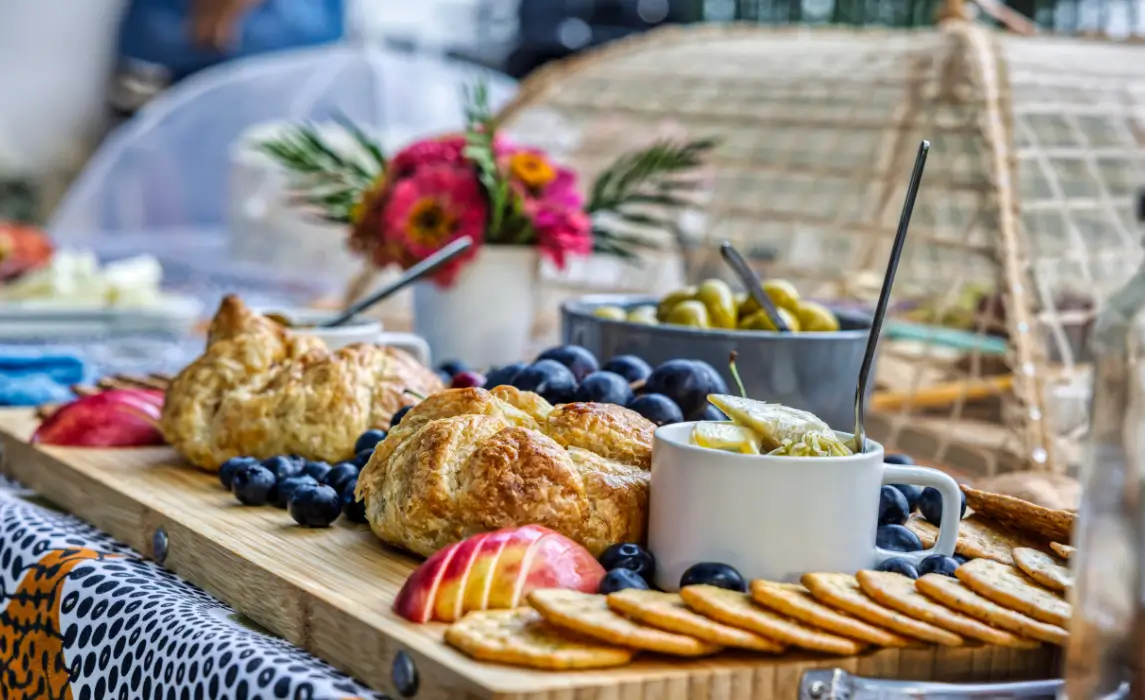
Start with your bowls. Ramekins or small ceramic dishes filled with dips and spreads go on first. They take up real estate and anchor your layout. A common mistake is adding them last and then finding no natural space for them.
Next come your large items, a whole brie wheel, a wedge of aged cheddar, a generous cluster of grapes, a folded stack of cured meat. Place them in different areas of the board rather than clustered together. The goal is to make the eye travel across the whole spread, not land in one corner.
From there, fan out your meats and cheeses. Slice cheese into irregular pieces rather than neat squares, it looks more artisan and invites people to take a piece without feeling like they're "breaking" something. Fold prosciutto into loose ribbons. Fan salami into overlapping circles. It takes thirty seconds and makes a visible difference.
Fill in with produce and crackers next. Cluster fruit near cheeses that complement it, grapes near brie, apple near cheddar. Stack crackers in short rows or fans. Tuck cucumber slices and cherry tomatoes into gaps. The goal is visual density without chaos.
Scatter your smallest items last. Nuts, dried fruit, chocolate pieces, and olives fill every remaining gap. If you can still see the board surface in several places, keep going with these small fillers until the board looks full.
Finish with a drizzle of honey directly over a soft cheese, a few sprigs of rosemary or thyme tucked into natural crevices, and, if you have them, a few edible flowers placed at key points. These details take two minutes and are the difference between a board that looks good and one that makes people stop to take photos.
The Mistakes That Make a Board Look Amateur
Building it too far ahead.
Crackers go soggy, cut fruit browns, and soft cheeses dry out faster than you'd expect. Assemble the board one to two hours before serving at most. Prep your components earlier, slice cheese, portion meats, wash produce, and store them separately, then assemble close to the time guests arrive.
Underestimating quantities.
A sparse board looks sad and runs out fast. The abundance is the point. For a snack spread, plan for two to three ounces of cheese and two ounces of meat per person. If the board is the main food, no dinner following, increase to four to five ounces of cheese and three to four ounces of meat, with proportionally more produce and crackers. Round up. Leftover ingredients from a grazing board are never a problem.
Skipping the tools.
Leave out small spreaders or cheese knives for each type of cheese, toothpicks or small tongs for items that are tricky to grab, and tiny spoons for dips. It sounds minor but makes a real difference in how easily and confidently guests serve themselves.
Placing everything randomly.
A board reads better when similar items are grouped rather than scattered. Clustering creates a sense of intention even when the arrangement is loose and organic. Random placement reads as a lack of thought, even when the ingredients themselves are excellent.
Read Related Article: Best Glass Drink Dispensers for Beverages: Perfect for Summer Parties and Outdoor Events
Find the best glass drink dispensers for beverages ideal for summer parties and outdoor events. Serve refreshing drinks in style with durable, elegant dispensers perfect for entertaining guests with ease.
Read More
A Few Ready-to-Use Board Ideas
If you'd rather not start from scratch, here are four combinations that work reliably well.
A classic wine night board keeps it simple and universally pleasing: brie, aged cheddar, manchego, prosciutto, salami, red and green grapes, fig jam, honey, walnuts, water crackers, and sliced baguette.
A vegetarian board that doesn't feel like a compromise: whipped feta, goat cheese log, aged gouda, hummus, roasted red peppers, Persian cucumber, cherry tomatoes, kalamata olives, dried apricots, seeded crackers, and warm pita.
A sweet and savory brunch board that works as well at 10am as it does at noon: cream cheese, brie, fresh strawberries, blueberries, sliced banana bread, honey, mini croissants, fig jam, Nutella, granola clusters, and sliced almonds.
A holiday board that photographs beautifully and feels seasonal: aged gruyère, cranberry cheddar, blue cheese, prosciutto, soppressata, pomegranate seeds, rosemary sprigs, dried cranberries, honeycomb, dark chocolate pieces, fig jam, and a generous selection of crackers.
The Honest Truth About Grazing Boards
There's no technique to master here, no timing to nail, and no single correct version of a grazing board. The format rewards instinct and personal taste more than it rewards precision. You'll get better at reading quantities, at knowing which combinations your particular crowd gravitates toward, and at building faster as you go.
Start with the basics, three cheeses, two crackers, a generous pile of produce, and a couple of dips. Nail that first. Then experiment with seasonal ingredients, themed boards, or unexpected additions like whipped ricotta with hot honey or a wedge of something funky that makes people curious.
The best grazing board you'll ever make is almost certainly still ahead of you. But the one you build this weekend will be more than good enough.
FAQs
How far in advance can I make a grazing board?
Fully assembled, no more than one to two hours ahead. That said, you can do most of the prep much earlier, slice cheese, portion meats, wash and dry produce, and refrigerate everything separately. In the last fifteen to twenty minutes before guests arrive, assemble the board and add crackers, fresh herbs, and anything that wilts or dries quickly. That window gives you a relaxed, unhurried finish.
How much food do I need per person?
For a snack or starter alongside other food, two to three ounces of cheese and two ounces of meat per person is a reliable baseline. If the board is the main event with nothing else following, double it, and be generous with the produce and crackers to compensate. It's always better to have more board than not enough.
Do I need a wooden board?
No. The wooden board is an aesthetic choice, not a functional requirement. Marble slabs, slate tiles, large ceramic platters, sheet pans lined with parchment, all of them work, and some photograph better than wood. What actually matters is surface area. Give your ingredients room to spread out. A cramped board looks messy no matter how good the ingredients are. A board with breathing room looks intentional.



.webp)
.webp)
.webp)