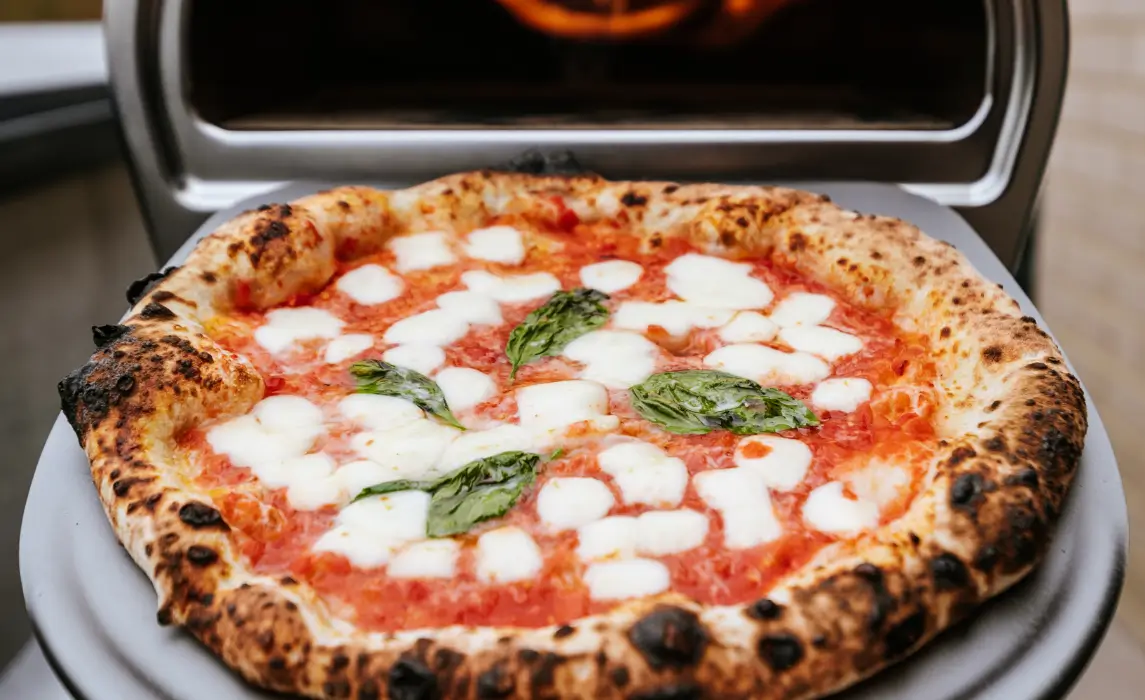
Quick answer: A portable pizza oven reaches 750–950°F and bakes a 12-inch pizza in 60–90 seconds, which makes it one of the easiest ways to feed a group outdoors. One oven and one confident cook can turn out roughly 15–20 pizzas an hour. For most hosts, a 12–13 inch gas oven in the $300–$500 range is the right starting point. Go bigger only if you regularly feed eight or more people.
A pizza party works because the cooking becomes the entertainment. Guests gather around the oven, stretch their own dough, argue about toppings, and watch a pizza puff and char in front of them. Your kitchen oven can't create that moment. At 500°F it needs 10–12 minutes per pie, so the host spends the evening stuck inside while the food comes out in slow, uneven waves.
The tricky part is that "portable" covers everything from a 26 lb oven you can carry to a beach to a 60 lb unit that rarely leaves the patio. This guide helps you choose the right one for the way you host, then walks you through running the party itself, from how much dough to make to where to set up the topping bar.
What makes a portable pizza oven different
It is not just a hotter grill. A portable pizza oven has a low, domed ceiling that rolls heat across the roof and down onto the toppings. A grill lid sits too high to do that, which is why grilled pizza often has melted cheese on a crust that never quite sets.
Underneath is a thick stone floor, usually cordierite about 10–20 mm thick, that stores heat and cooks the base from below. Ceramic insulation between the inner and outer shell keeps that heat inside the oven rather than leaking into the air. The thicker the stone and the better the insulation, the faster the oven recovers between pizzas, and recovery is what matters most when you're feeding a queue of hungry guests.
Most of the skill comes down to balancing top heat and bottom heat. If the air is hotter than the stone, you get scorched toppings on a pale base. If the stone runs hotter, the bottom burns before the cheese melts. The cooking section below covers how to manage that during a busy night.
A portable oven suits anyone who hosts regularly, likes cooking outdoors, or wants a crowd-pleaser for camping trips and tailgates. If you mostly make thick, pan-style pizza for the family, a pizza steel in your kitchen oven does that well for a fraction of the cost.
Read Related Article: French Christmas Dinner Menu: A Traditional Réveillon, Course by Course
Discover a traditional French Christmas dinner menu, from festive appetizers and classic main courses to elegant desserts served during Réveillon celebrations.
Read More
Gas, wood, pellet or electric: which fuel fits you
Fuel decides more about daily life with the oven than any other spec. It sets how fast you can start, how much attention the fire needs, and where you are allowed to use it.
| Fuel |
Typical Max Heat |
Effort |
Flavor |
Best For |
Watch Out For |
| Propane gas |
900–950°F |
Low: turn a knob |
Clean, no smoke |
Beginners, weeknights, tailgates |
Wind can blow out or weaken the flame; tank adds 30+ lb when full |
| Wood (logs/kindling) |
900–950°F |
High: feed every few minutes |
Smoky, the classic taste |
People who enjoy tending fire |
Ash, sparks, burn bans, a learning curve |
| Wood pellets |
850–950°F |
Medium: top up the hopper |
Light smoke |
Wood flavor with less fuss |
Pellets must stay dry; uneven heat if the hopper runs low |
| Charcoal |
700–900°F |
Medium |
Mild smoke |
Slower-cooked breads and roasts |
Slower to reach top heat than wood or gas |
| Multi-fuel (wood/charcoal + gas burner) |
950°F |
Your choice |
Your choice |
Anyone unsure which way to go |
Gas burner is often sold separately ($100+) |
| Electric |
700–850°F |
Lowest |
None |
Apartments, flame-restricted areas, indoor use |
Smaller pizzas, needs a solid outlet |
For hosting, gas is the practical choice for most people. Once the party starts, you will be stretching dough, chatting, and refilling drinks. A wood fire needs a log every few minutes, and a forgotten fire means the next three pizzas come out pale. Gas holds steady heat with no attention. If you love the ritual and smoke of wood, a multi-fuel oven lets you cook with gas when the crowd is big and with wood on quieter evenings.
Check where you plan to use it before you buy. Fire codes in many U.S. cities limit full-size propane tanks on apartment balconies, and many leases ban open flames entirely, so electric is the safe default there. If your parties tend to happen at campsites or parks, keep in mind that fire restrictions usually hit wood and charcoal first. Many sites still allow gas appliances with an on/off valve during a burn ban, though it's always worth confirming with the site.
Electric ovens bring their own catch. A 1,600 W model pulls about 13 amps on a 120 V circuit, so plug it straight into a wall outlet rather than an extension cord. Avoid running a kettle, slow cooker, or party speakers on the same circuit, or you may trip the breaker mid-pizza.
What to check before you buy
Ignore the "60-second pizza" headline. Nearly every oven on the market reaches 900°F, so speed no longer separates a good oven from a bad one. For hosting, what matters is how many pizzas you can serve in a row, how easily you can move the oven, and how forgiving it is when you're distracted.
Recovery time beats peak temperature. The stone loses heat with every pizza. A thick cordierite stone (15 mm or more) and good insulation bring it back up in about a minute, while thin stones can take two or three. Over a 20-pizza evening, that difference adds up to half an hour of guests waiting by an empty oven.
Size the mouth for your crowd. A 12-inch oven comfortably bakes a 10–11 inch pizza with room to turn it. That's plenty for groups of up to about eight. If you regularly host ten or more, a 14–16 inch oven lets you bake bigger pies to share, so you need fewer launches overall. The trade-off is weight: most 16-inch ovens stay on the patio.
Count the full carry weight. A full 20 lb propane tank weighs about 37 lb on its own. Add a peel, a stand, and a cover, and a "30 lb" oven turns into a 70 lb load. If you plan to bring the oven to a friend's house or a campsite, stick to models under 30 lb with folding legs or a carry bag.
Look at the burner layout on gas models. A single rear burner works, but it scorches the back edge faster and needs more turning. An L-shaped or side burner spreads heat more evenly, which means fewer burnt crusts when you're juggling conversation and a peel.
Don't trust the built-in thermometer alone. Most measure the air, not the stone. An infrared thermometer pointed at the center of the stone is the only reliable way to know you're ready for the next pizza.
Finally, budget $80–$150 on top of the oven for a launching peel, a small round turning peel, an infrared thermometer, and a waterproof cover. Brand "essentials bundles" usually cost less than buying each piece separately.
Read Related Article: Best Candy Bars for Parties, Movie Nights, and Hosting
Discover the best candy bars for parties, movie nights, and gatherings, with crowd-pleasing favorites, chocolate treats, and sweet options for every occasion.
Read More
Popular portable pizza ovens compared (late 2026)
For most people, the sweet spot is a 12–13 inch gas or multi-fuel oven between $300 and $500. Prices below are U.S. list prices; sales of 20–30% are common around holidays, so rarely pay full price.
| Model |
Fuel |
Max Pizza |
Weight |
Max Temp |
U.S. List Price |
Best For |
| Ooni Koda 12 |
Gas |
12 in |
~20 lb (approx.) |
950°F |
$299 |
Lowest-cost, simplest start |
| Ooni Karu 12 (1st gen) |
Multi-fuel |
12 in |
~26 lb |
950°F |
$349 (often $249 on sale) |
Wood flavor on a budget |
| Solo Stove Pi Prime |
Gas |
13 in |
30 lb |
950°F |
$349–$450 |
Beginners; front temperature knob |
| Ninja Woodfire Outdoor Oven |
Electric + pellets for smoke |
12 in |
~32 lb (approx.) |
700°F |
$399.99 |
Pizza plus roasting, smoking, baking |
| Ooni Karu 2 (12G) |
Multi-fuel |
12 in |
27.6 lb |
950°F |
$449 |
Best all-round carry-anywhere pick |
| Gozney Tread |
Gas |
12 in |
29.7 lb |
950°F |
$499 |
Camping, tailgating, small patios |
| Gozney Roccbox |
Gas (wood burner add-on) |
12 in |
44 lb |
950°F |
$499.99 (often $399.99) |
Thick insulation, cool-touch jacket |
| Ooni Volt 2 |
Electric (1,600 W) |
12 in |
38.8 lb |
— |
$699 |
Indoor use, apartments |
| Gozney Arc XL |
Gas |
16 in |
58.5 lb |
950°F |
$999.99 |
Big families; "movable," not truly portable |
How to read this table: under 30 lb, you can carry the oven alone to a car or campsite. Between 30 and 45 lb, it moves between patio and garage but you won't want to hike with it. Above 45 lb, treat it as a fixture you move a few times a year.
The Ninja is the outlier: it runs on electricity and only uses pellets for flavor, so it tops out around 700°F. That gives a New York–style crisp rather than a soft, leopard-spotted Neapolitan crust, but it doubles as a smoker and roaster.
For hosting specifically, the Gozney Tread and Ooni Karu 2 balance portability with steady heat, and the Solo Stove Pi Prime's front knob makes it easy to adjust mid-party. If you regularly feed a big crowd at home and don't need to move the oven, a 16-inch model like the Arc XL saves the most time per guest.
How to host a pizza party with a portable oven
A good pizza party is mostly planning. The oven only works for about two hours, but the dough, layout, and timing decide whether those two hours feel relaxed or frantic.
Plan your pizzas per hour first. Each 12-inch pizza takes 60–90 seconds to bake, but you also need time to stretch, top, launch, and let the stone recover. Realistically, one person running the oven alone makes 15–20 pizzas an hour. Add a helper who stretches and tops while you bake, and you can reach 20–25. Plan on one 12-inch pizza per adult and half a pizza per child, then add two or three extra for second rounds. A group of 10 adults and 4 kids needs about 14–15 pizzas, which one oven handles comfortably in under an hour.
Do the dough math the day before. A 250–270 g dough ball makes one 12-inch pizza, so 15 pizzas need roughly 4 kg of dough. Mixing it 24–48 hours ahead and letting it rest in the fridge gives a more flavorful, easier-to-stretch crust, and it takes the biggest job off your party-day list. If making dough isn't for you, many pizzerias and supermarkets sell fresh dough balls; just ask a day or two ahead for a large order.
Set up a flow, not a pile. Arrange your space in the order a pizza travels: dough station, then topping bar, then the oven, then a cutting board and serving table. Keep guests on the topping side and only one or two people near the oven mouth. Place the oven with its back to the wind, at least 3 ft from walls and fences, and keep the propane tank on the side away from foot traffic. A headlamp or a clip-on light near the oven helps once the sun goes down; it's hard to judge a crust in the dark.
Keep toppings simple and spread thin. At 900°F, heavy or watery toppings leave a soggy center. Set out six to eight options in small bowls, pre-cook anything wet like mushrooms or sausage, and grate cheese ahead. Letting guests build their own pizzas is half the fun, but put a gentle limit on how much goes on each pie.
| When |
What to Do |
| 1–2 days before |
Mix dough, divide into balls, refrigerate. Check you have a full propane tank. |
| Morning of |
Prep toppings, grate cheese, set up tables and lighting. |
| 2 hours before |
Take dough out of the fridge so it reaches room temperature. |
| 45 minutes before |
Light the oven so the stone is fully heated when guests arrive. |
| Guests arrive |
Bake a simple margherita first to check the heat, then let guests build their own. |
| After the last pizza |
Leave the oven on high for 10 minutes to burn off spills, then let it cool fully before covering. |
Cooking tips that save the night
Most failed pizzas fail at the launch, not in the oven. Practice two or three pizzas on your own before the first party; guests are forgiving, but a stuck pizza folded onto the stone is a messy start.
Use a dough made for high heat: 60–65% hydration (600–650 g water per 1 kg flour) and no sugar or oil, since both burn quickly at 900°F. Before the first launch, check the stone with an infrared thermometer. Around 750–850°F at the center is a good range for Neapolitan-style pizza.
Dust the peel lightly with flour or a flour–semolina mix, but go easy on the semolina, because too much burns on the stone and tastes bitter by the fifth pizza. Build the pizza quickly on the peel and give it a small shake before launching. If it doesn't slide freely, lift the edge and toss a pinch of flour underneath. This is where many hosts get caught out at parties: guests take their time choosing toppings, the dough sits on the peel, and it sticks. Having guests build on a floured counter or a second peel, then sliding it onto the launching peel at the last moment, solves most of that.
On gas ovens, turn the flame down right after launching so the base can catch up with the top, then turn it back up once the pizza comes out. Rotate the pizza every 15–20 seconds with a small round turning peel, since the side facing the flame cooks much faster. Then give the stone a minute or two to recover before the next launch. Rushing the next pizza is the main reason bases come out pale and soft later in the evening.
If something goes wrong mid-party, this quick reference covers the usual culprits:
| Problem |
Likely Cause |
Fix |
| Burnt top, raw base |
Air hotter than stone |
Preheat longer; lower flame after launch. |
| Burnt base, pale top |
Stone too hot |
Let it cool 2–3 minutes; leave the flame on high. |
| Pizza sticks to peel |
Wet dough or slow build |
Less sauce, more dusting, build faster. |
| Soggy center |
Too many toppings |
Go lighter; pre-cook watery vegetables. |
| One side charred |
Not rotating enough |
Turn more often, especially near the flame. |
Safety, cleaning and storage
With a crowd around, safety is mostly about where the oven sits and who gets close to it. Set it on a stable, non-flammable surface such as stone, metal, or a purpose-built table, never a plastic or glass-topped patio table, and never directly on a wooden deck without a heat-resistant barrier. Gas, wood, and pellet ovens must stay outdoors and out of garages or low covered porches, because carbon monoxide builds up quickly.
Steel-shelled ovens stay dangerously hot for an hour or more after the last pizza, which matters at parties with kids and pets running around. A simple fix is to mark off the oven area with the serving table or a couple of chairs so the only people near the mouth are the ones cooking. Silicone-jacketed models are cooler to the touch, but the opening is still very hot. If you've just connected a new propane tank, brush soapy water over the hose joints and open the valve; bubbles mean a leak to fix before lighting.
Cleaning takes minutes. Never put water or soap on the stone. A splash of cold water on a hot stone can crack it, and soap soaks into the porous surface. Instead, run the oven on high for 10–15 minutes after cooking to burn off spilled cheese and sauce, then brush the ash away once cool. Stubborn marks disappear if you flip the stone on your next cook, and dark spots are normal. Wipe the shell with a damp cloth when it's cold, and empty ash from wood or pellet ovens after every use, since damp ash corrodes metal.
Between parties, keep the oven under a fitted waterproof cover, and bring it indoors during winter or the rainy season if you can. A stone that has absorbed moisture can crack on a fast, hot start, so preheat gently after long storage. Store propane tanks outdoors, upright, and away from the house, never inside or in a closed car.
Frequently asked questions
Is a portable pizza oven worth it?
Yes, if you make pizza at least twice a month or like cooking outdoors with friends. It produces a crust a home oven can't match. If you only make pizza a few times a year, a pizza steel in your kitchen oven is a cheaper upgrade.
How many people can one portable pizza oven feed?
One 12-inch oven and one cook can serve about 15–20 pizzas an hour, enough for a party of 15–20 people if you plan one pizza per adult. With a helper prepping pizzas, that rises to 20–25 an hour.
How much dough do I need for a pizza party?
Plan one 250–270 g dough ball per adult and half a ball per child, plus two or three extras. For ten adults, that's about 3–3.5 kg of dough.
Gas or wood: which is better for beginners?
Gas. It lights with a knob, holds steady heat, and lets you focus on dough and launching. You can add a wood or multi-fuel oven later once the basics feel easy.
How long does it take to heat up?
Plan for 20–30 minutes. Brands often quote 15 minutes, but the stone takes longer to fully heat, especially in cold or windy weather.
Can I use a portable pizza oven indoors?
Only electric models designed for indoor use, such as the Ooni Volt 2 or Breville Pizzaiolo. Gas, wood, pellet, and charcoal ovens must stay outdoors because of carbon monoxide.
How long does a propane tank last?
It depends on flame setting and weather. A standard 20 lb tank usually covers several pizza nights. Weigh the tank before and after a session to learn your own oven's usage.
Can I cook more than pizza?
Yes. Steaks, roasted vegetables, flatbreads, fish, and skillet dishes all work well. Use a cast-iron pan and lower the heat to around 600°F for anything thicker than a pizza.
What size oven do I need?
A 12-inch oven feeds 2–4 people comfortably, one pizza at a time. For regular groups of six or more, a 16-inch oven saves time but adds weight and cost.
Can I use it on a balcony?
Check your lease and local fire code first. Many buildings restrict propane tanks and open flames on balconies. An electric oven is usually the safest option.