A great dinner party table needs three things: a place setting that matches your menu, one statement element (linens, flowers or candles), and nothing that blocks guests from seeing each other. Get those right and plain white plates will look intentional.
Most hosts overthink the decor and underthink the practical stuff: whether eight people actually fit, where the serving dishes land, and whether the candles will survive the evening. This guide covers both, so the table looks good at 7 p.m. and still works at 10.
How to set a table for a dinner party
Forks go left, knives and spoons go right, glasses sit above the knife, and utensils are used from the outside in.
- Base: set a placemat or charger about 2.5 cm (1 in) from the table edge, centered on the chair.
- Plates: dinner plate on the base; a salad plate or soup bowl stacks on top if that course comes first.
- Left side: dinner fork closest to the plate, salad fork outside it.
- Right side: dinner knife with the blade facing the plate, then a soup spoon if needed.
- Glasses: water glass above the knife tip, wine glasses to its right in pouring order.
- Extras: bread plate above the forks with a butter knife across it; dessert spoon or fork laid horizontally above the plate; napkin on the plate or left of the forks.
The trick guests use too: make an "OK" sign with both hands. The left forms a b (bread), the right a d (drink). Bread plate left, drinks right, no more stealing a neighbor's roll.
Left-handed guests: don't flip their setting, since it throws off the people beside them. Seat them at a left corner or end instead, where their elbow has open space.
Casual vs. formal: only set what the menu needs
| Element |
Casual Dinner |
Formal Dinner |
| Base |
Placemat or bare wood |
Tablecloth + charger |
| Utensils |
1 fork, 1 knife, dessert spoon if needed |
One per course, max 3 per side |
| Glasses |
Water + one all-purpose wine glass |
Water, white, red |
| Bread Plate |
Optional |
Expected |
| Place Cards |
Rarely |
Standard for 8+ guests |
If a guest won't use a piece, leave it off. A cluttered setting reads as fussy, not formal.
Before you style: will everyone actually fit?
Each guest needs about 60 cm (24 in) of table edge to eat comfortably, and 70 cm (28 in) for a formal setting with a charger and three glasses. Measure your table before you send invitations, not on the day.
| Table |
Comfortable |
Squeezed |
| Round, 120 cm (48 in) |
4–5 |
6 |
| Round, 150 cm (60 in) |
6–8 |
8 |
| Rectangle, 150 cm (5 ft) |
6 |
6–7 |
| Rectangle, 180 cm (6 ft) |
6–8 |
8 |
| Rectangle, 240 cm (8 ft) |
8–10 |
10 |
Round tables keep one conversation going; long tables naturally split into two or three. For a long table, seat the most talkative guests in the middle and put yourself nearest the kitchen.
Tablecloth math: table length + 60 cm (24 in) and table width + 60 cm gives a 30 cm (12 in) drop on every side, the standard for dinner. A 180 × 90 cm table needs a 240 × 150 cm cloth (a standard 60 × 90 in cloth in US sizes).
Read Related Article: 7 Quick Christmas Desserts You Can Actually Finish Before Guests Arrive
Try these 7 quick Christmas desserts you can finish before guests arrive, with easy recipes, simple ingredients, and festive flavors everyone will enjoy.
Read More
12 table setting ideas for a dinner party
Each idea lists what to buy or pull from the cupboard, plus the one detail that makes it work. Mix freely: a monochrome palette works inside a rustic setup, and personalized touches fit any style.
1. Modern minimalist
You need: white plates, matte black or brushed steel flatware, 5–7 bud vases with one stem each.
What makes it work: empty space. Leave at least a hand's width between each vase so the table looks edited, not sparse. Best for plated menus and small apartments.
2. Rustic farmhouse
You need: flax or burlap runner, stoneware, amber or recycled glassware, fresh rosemary and kitchen twine.
What makes it work: a rosemary sprig tied around each napkin. It smells like dinner and costs almost nothing. Pairs naturally with roasts and family-style platters.
3. Garden party
You need: floral or gingham napkins, mismatched vintage plates, flowers in jam jars or tin cans.
What makes it work: repeating one bloom color across every jar, so the mismatched dishes still look like a set. Made for daytime and outdoor dinners.
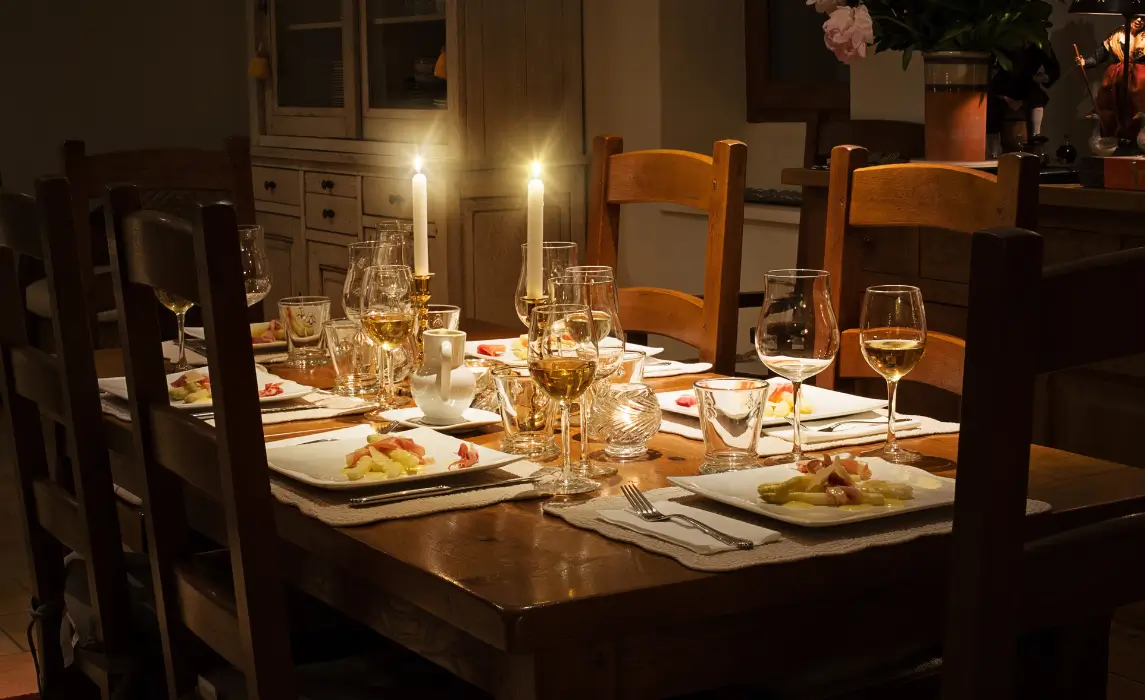
4. Moody candlelit
You need: a dark tablecloth (charcoal, navy or forest green), brass or gold flatware, 10–15 tapers.
What makes it work: volume. A handful of candles looks like an afterthought; a dense cluster at three heights looks like a restaurant. Ideal for winter, anniversaries and late dinners.
5. Coastal
You need: blue-and-white plates, natural linen napkins, rattan or seagrass placemats.
What makes it work: restraint. Skip the shell piles and let one texture (rattan) and one color (blue) carry the theme. Pairs with grilled fish, ceviche and kinilaw.
6. Grazing table
You need: butcher paper or a linen runner, 2–3 large boards, small plates and cocktail napkins at each seat.
What makes it work: the food is the centerpiece, so build height with a cake stand or upturned bowl under one board. Plan about 150 g (5 oz) of cheese and charcuterie per guest if it's the main meal.
7. Monochrome
You need: napkins, glassware and flowers in three shades of one color (for example sage, olive and deep green).
What makes it work: keeping plates and tablecloth neutral so the color reads as a choice. The fastest way to make an ordinary table look styled.
8. Collected and eclectic
You need: patterned and thrifted plates, vintage glasses, one napkin color for every seat.
What makes it work: the shared napkin color is the thread that turns "we didn't have enough matching dishes" into a look. Thrift shops and ukay-ukay stores are full of single plates for pocket change.
9. Classic formal
You need: white tablecloth, chargers, full flatware, stemware, handwritten place cards.
What makes it work: pressing. A wrinkled tablecloth ruins a formal table faster than anything, so iron it on the table itself, after it's in place. Reserve for milestone birthdays and holiday dinners.
10. Seasonal harvest
You need: whatever's in season and cheap: mini pumpkins and pears in autumn, citrus and pomegranates in winter, mangoes and calamansi in a Philippine summer.
What makes it work: using produce instead of flowers means nothing goes to waste. Send guests home with a piece of fruit.
11. Menu-led
You need: serveware and textures from the cuisine you're cooking.
What makes it work: letting the food set the scene. A Filipino boodle fight runs banana leaves down the table with rice and dishes laid directly on top, eaten by hand. A Japanese-inspired dinner uses chopstick rests, small ceramic dishes and one ikebana-style branch.
12. Personalized seats
You need: name tags (leaves, tags, folded cards), a printed or handwritten menu, a small take-home favor.
What makes it work: specificity. A menu card that names the dish ("Lola's adobo") or a favor tied to the evening gets photographed and remembered. Works with every style above.
Read Related Article: 15 Easy Thanksgiving Desserts That Don't Require a Culinary Degree (or a Full Day in the Kitchen)
15 easy Thanksgiving desserts with simple ingredients, beginner-friendly steps, and time-saving ideas—perfect for a festive spread without spending all day in the kitchen.
Read More
Centerpieces, linens and lighting
These three set the mood more than the plates do, so they're where a small budget goes furthest.
Centerpieces: do the elbow test
Sit down, rest an elbow on the table and raise your fist. Anything taller than your knuckles, roughly 30 cm (12 in), blocks the person across from you. Go low and long instead: a line of bud vases, a greenery garland or a row of fruit. Thin tapers and see-through branches are the only tall pieces that pass.
- Skip lilies: their pollen stains linens permanently. Pull the anthers if you use them.
- Skip heavy scents near food: gardenias, tuberose and sampaguita compete with the meal.
- Arrange flowers the day before. Most blooms open up overnight and look fuller by dinner.
- On a family-style table, platters need the middle. Keep decor to a narrow strip or move it to the ends.
Linens: sizes that look right
- Napkins: dinner napkins are 50 cm (20 in) square. Smaller "lunch" napkins look skimpy folded on a plate.
- Runner: table length plus 15–30 cm (6–12 in) of overhang at each end. On a bare table, use two runners across the width instead, so each pair of guests shares one.
- Fabric: linen and cotton absorb spills and look better after washing. Polyester repels stains but slides around under plates.
Lighting: warm, low and lasting
Turn overhead lights to warm white (2,700K) and dim them by half, then let candles carry the table. A standard 25 cm (10 in) taper burns for about 7–9 hours, enough for any dinner; tea lights last 3–4 hours, so light them just before guests sit.
Hot or humid weather: tapers soften and bend above about 30°C (86°F). Chill them in the fridge for an hour beforehand, and use glass hurricanes or votive holders if a ceiling or electric fan is running, since moving air causes dripping and blowouts. Orchids, anthuriums and greenery hold up far longer in the heat than roses or hydrangeas.
What it costs to set a table for 8
A polished table for eight can cost about USD 40 (PHP 2,300) using dishes you already own.
| Item (8 Guests) |
Budget |
Mid-range |
Splurge |
| Cloth Napkins |
USD 12 / PHP 700 |
USD 30 / PHP 1,750 |
USD 80 / PHP 4,650 |
| Runner |
USD 8 / PHP 450 |
USD 25 / PHP 1,450 |
USD 60 / PHP 3,500 |
| Candles |
USD 8 / PHP 450 |
USD 20 / PHP 1,150 |
USD 50 / PHP 2,900 |
| Flowers or Greenery |
USD 10 / PHP 600 |
USD 35 / PHP 2,050 |
USD 120 / PHP 7,000 |
| Chargers |
Skip |
USD 30 / PHP 1,750 |
USD 100 / PHP 5,800 |
| Place and Menu Cards |
USD 2 / PHP 120 |
USD 10 / PHP 580 |
USD 40 / PHP 2,300 |
| Total |
USD 40 / PHP 2,300 |
USD 150 / PHP 8,700 |
USD 450 / PHP 26,000 |
Approximate 2026 retail ranges at about PHP 58 to USD 1.
Where to spend first: napkins, then candles, then greenery. Napkins get reused for years and change every seat at once; candles transform the room for a few dollars; greenery fills the center for less than flowers. Chargers come last, since they only make sense for formal dinners.
Free or nearly free: garden clippings, herbs from the kitchen, borrowed glassware, and fruit you'll eat later anyway.
A setup timeline that saves the evening
Set the table the day before. It's the one habit that separates calm hosts from frazzled ones.
- One week out: pick the style, count seats against your table size, and borrow or order anything missing.
- Three days out: wash and press linens; polish glasses with a lint-free cloth to remove water spots.
- The day before: set everything, then sit in two or three chairs to check sightlines and elbow room. Arrange the flowers.
- One hour before: fill water glasses, chill the wine, dim the lights. Light candles as the doorbell rings.
Mistakes that only show up mid-dinner
- No landing zone for platters. Before decorating, place every serving dish on the table empty to see where it fits.
- One salt and pepper for ten people. Put out one set per four guests so nobody has to ask twice.
- Unreadable place cards. Pale ink and script fonts vanish in candlelight. Use dark ink and letters at least 1 cm tall.
- Chairs straddling table legs. Check corners and legs before assigning seats; the guest who gets the leg will notice all night.
- Nowhere for the wine and water pitcher. A small side table or tray keeps bottles off the main table and stops tipping.
The table is the setting, not the show
Guests rarely remember the napkin fold. They remember that they could hear each other, that there was room for their elbows, and that the host sat down and stayed. Every idea above is in service of that.
Three habits make the next dinner easier than this one:
- Photograph the finished table before guests arrive. Next time, you have a setup to copy instead of a blank table to solve.
- Keep a host note on your phone: who came, what they didn't eat, which seat worked for whom. It turns a good dinner into a personal one the second time around.
- Shuffle seats for dessert. Moving half the guests one or two chairs after the main course gives everyone a new conversation partner, and it's the easiest way to keep a long table lively past 10 p.m.
Pick one style, set it the night before, and spend the evening at your own party.
Frequently asked questions
How do you set a buffet table for a dinner party?
Arrange it in the order guests serve themselves: plates first, then mains, sides, sauces and bread, with utensils rolled in napkins at the far end so hands stay free. For more than 20 guests, set food on both sides of the table to create two lines.
What's the difference between a place setting and a table setting?
A place setting is the plate, utensils, glasses and napkin for one guest. A table setting is the whole picture: every place setting plus linens, centerpiece, candles and serving dishes.
Should couples sit together at a dinner party?
At formal dinners, tradition splits couples and alternates guests so conversation mixes. At casual dinners, seat people where they'll be comfortable; new couples and anyone who knows only their partner usually prefer to sit together.
How do you set a table when kids are coming?
Give kids the end closest to the kitchen, use stemless or unbreakable cups, and keep candles away from their side. A paper runner with crayons at their end keeps them seated through the main course.
When should you clear plates?
Wait until everyone at the table has finished the course, then clear from each guest's right. Clearing early can make slower eaters feel rushed.
How do you set a table outdoors?
Clip or weight the tablecloth corners, put candles in hurricanes or lanterns, and cover food until it's served. Keep citronella or insect coils at the edge of the space, not on the table, so the smoke doesn't drift over the food.


-p-800.webp)
.webp)
.webp)